Skip to page content or skip to Accesskey List.
Search evolt.org
evolt.org login: or register

Work

Main Page Content

Never Say No - Managing Change in a Project

Rated 3.91 (Ratings: 1) (Add your rating)

Log in to add a comment
(7 comments so far)

Want more?

 
Picture of MartinB

Martin Burns

Member info | Full bio

User since: April 26, 1999

Last login: May 10, 2008

Articles written: 126

So, your project is up and running. You've defined Project Requirements and had them signed off in blood by the sponsor. All you need to do now is watch your New Model Army get on and deliver. Right? Ahhh no. Life is never that simple, and you can reasonably safely bet hard currency that the requirements will change during delivery. Managing those changes is a potential cause of massive disruption to your project and your relationship with the client if you don't do it well.

Never Say No To a Client

Change is Bad

It's often said that Salespeople never say No. And it's often true - whatever the customer asks for, they invariably say Yes, we can do that. And Project Managers generally hate that as it paints us into a corner where our projects are not under our control. Some PMs therefore retreat into a Yoda-like mantra:

  • Saying Yes leads to Change
  • Change leads to Lack of Control
  • Lack of control leads to Suffering (which is a PM technical term for missing deadlines, budgets or quality objectives)

But as a client-facing PM, you soon learn that to say No is just unacceptable to most clients. It's seen as pure stonewalling; that you're not prepared to be cooperative, or (worse) that your team just isn't competent. Either can cause you serious problems in your sponsor relationship, maintaining which is one of your top priorities.

Change is Good

On the other hand, saying Yes to client requests tends to result in more work. In the other Yoda mantra:

  • Saying Yes leads to Change
  • Change leads to More Work
  • More Work leads to Happiness (another PM technical term for Increased Project Revenue and Gross Profit, which you're often responsible for)

Balance - a Neat Trick

Balancing between stonewalling (pretending that nothing can be changed and rejecting all proposed changes) and accepting all proposed changes and causing major project control problems is a tough act. Trying to work it out mid-project is even tougher. Trying to work it out on the hoof is nigh on impossible. Here's the basic magic formula - if you take nothing else away from this article, take the following sentence. Put it in your wallet, stick it to your monitor, brand it on the back of your hand:

Your request makes sense, but it raises potential risks and issues that might cost time and money.

Use The Sentence even if the client request doesn't make sense. Some requests will, some won't, but The Sentence usually ends up with one of 2 results:

  1. Client backs off
  2. Client agrees to more time, more money or lower quality

In either case, it's a useful holding action that then lets you wheel out the Change Control Process that you thoughtfully included in your standard statement of work.

Change Control Process

This is a process to consistently handle the inevitable Change Requests that crop up mid-project, ensuring that the good ones get through, with associated adjustments to the cost/time/quality Holy Trinity, but the bad ones don't. You maintain control of your project, you're contractually covered, the client gets what they want, but pays for it if necessary.

What is a Change Request?

This one's easy: A Change Request is any request that changes the Project Requirements.

Do We Need a Change Control Process?

Again, easy. Yes. Every project must have a change process. Every change request must use it.

Time and time again, I've heard inexperienced clients, developers and sales people starting to say things like: This project is too small/rapid/ low-budget to have a change process. or This change is too small to go through change control. To which I invariably respond: Only if the project policy is to refuse all change requests - which is of course a change process, just a really simple one to operate - or find yourselves another PM.

Strict? Yes. But here's why: because Project Requirements are a contractual document, any change to Requirements is also a contractual document. If the appropriate project authorities (the Sponsor and you) haven't signed up to a Change to the Requirements, you will fail UAT, your project won't be accepted by the sponsor, and there's a good chance you won't be paid.

Here's an example: a stakeholder has a wizard wheeze. It's a pretty simple change to the requirements and won't take much effort to implement. Realising this, the stakeholder takes it straight to one of the developers, who codes it up and tests it in a couple of hours. Doesn't break anything else, doesn't noticeably impact timescales or budgets. But come UAT, the Sponsor notes that the delivered site doesn't match the requirements, and rightly asks Where did I agree to this? You cannot allow your project to get to that point, because the only honest answer is You didn't with the enevitable followups of When did you agree to it? and Who died and gave you authority over what I want. That's A Bad Place to be.

You don't need to follow the same process for small CRs as large ones, though. You can use a light weight process for small CRs, as long as the 2 processes are documented and agreed, including - vitally - the definition of a small CR.

Sample Change Control Process

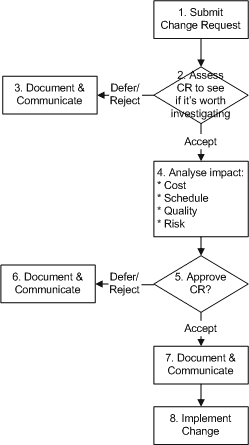
Here's an example of a simple Change Control Process. It's not the only possible process you could use, but it is in line with most PMI- compliant methodologies, so would be generally accepted by most professionally run projects.

  1. Someone submits a CR. You need to agree and document who is able to do this.
  2. Assess the CR to see if it's worth investigating. Here, you need to work out how long it's going to take to analyse the impact of the CR, and compare that with the projected benefits. This is a quick preflight check to weed out the obvious non-starters. If it's going to take a week just to work out how much change is involved, and the benefit is tiny, or there's not a hope in hell of it being accepted (for example, it changes the objective of the project) then this gets thrown in the bucket of CRs that are a waste of time from the outset.
  3. Document and Communicate. Essential for all outcomes of any process.
  4. Analyse the impact. Answers the questions: If we implement the change, how is it going to hit the Holy Trinity? What's the Risk?

    To do this, you will possibly need to replan a large chunk of the project - schedules, WBS, staffing, budgets and all. You may need time from developers for them to contribute - time they would otherwise spend delivering the project.

    You must have allowed for this in your original budget and schedule, and have it explicitly written into your contract. Avoiding doing this unnecessarily is why you had the pre-assessment in step 2.

  5. Document and Communicate
  6. Approve the CR? This is where you take your assessment and put it in front of your sponsor. It's then the sponsor who decides whether the CR should go ahead, accepting the changes in Schedule, Cost, Quality and Risk. If the sponsor decides against the CR, you've been co-operative and (I hope) objective in putting it forward, and you're not the one saying No.
  7. Document and Communicate
  8. Document and Communicate
  9. Implement Change

Which is where your developers think the real work starts.

Martin Burns has been doing this stuff since Netscape 1.0 days. Starting with the communication ends that online media support, he moved back through design, HTML and server-side code. Then he got into running the whole show. These days he's working for these people as a Project Manager, and still thinks (nearly 6 years on) it's a hell of a lot better than working for a dot-com. In his Copious Free Time™, he helps out running a Cloth Nappies online store.

Amongst his favourite things is ZopeDrupal, which he uses to run his personal site. He's starting to (re)gain a sneaking regard for ECMAscript since the arrival of unobtrusive scripting.

He's been a member of evolt.org since the very early days, a board member, a president, a writer and even contributed a modest amount of template code for the current site. Above all, he likes evolt.org to do things because it knowingly chooses to do so, rather than randomly stumbling into them. He's also one of the boys and girls who beervolts in the UK, although the arrival of small children in his life have knocked the frequency for 6.

Most likely to ask: Why would a client pay you to do that?

Least likely to ask: Why isn't that navigation frame in Flash?

discarded CRs

Submitted by djrein on December 8, 2005 - 21:44.

One question I have for his process is for Step #2, where you weed out the non-starters. Based on my limited project management experience, it seems like so many change requests fall into this category. If a change request gets thrown in bucket of CRs that are a waste of time from the outset, how is this communicated to the client? I’m sure you don’t say, “We determined that your change request was a waste of time?” Isn’t this then equivalent of saying no?

login or register to post comments

discarded CRs

Submitted by MartinB on December 9, 2005 - 00:35.

Naturally, you're making these decisions with your client, specifically the project sponsor - in fact, it should ultimately be their decision.

If they're not able to spot a waste of time, even with your recommendation, then sure, let them spend the N days of PM billable time coming to the same conclusion in complete detail. Think of it as an expensive form of training...

If at the end of all that, they still want the worthless change, despite all your recommendation, well, in the words of Dr Keyworth: Screw around if you want, but it's your money, it's about to be my money, and I sleep fine.

login or register to post comments

but it's your money...

Submitted by topdog1 on December 19, 2005 - 22:31.

"Screw around if you want, but it's your money, it's about to be my money, and I sleep fine." Wish I could sleep fine. I still get this issue (typical with websites) is that all the changes represent your acheivements at mind reading, not unlike telling a sculptor how to mould the wet clay on your behalf. Yes they know what they dont want, many know what they think they want(delivered as spec but business/market did not respond as predicted).

They can change their minds when the next new bit of tincle passes their eyes and the delivery/cost schedule goes out the window. Worse with smaller clients is that they are not that keen of PM activities versa pitface development(code now, think later). Explaining why the 'cost' have grown above initial estimates and maintaining good client relations becomes a bit strained/tricky.

From a PM viewpoint I so find comfort in nailing them to the floor change wise and suggest phases. BUT what if phases two includes undoing phase one? How do you deal with the 'Fixed cost' nature of many site developments, where as "Screw around as much as you want..." comment you just made which implies 'Time and Materials' which they dont like (cos it moves some responsiblities back on them)?

Or in short "How to get money out of your client"

login or register to post comments

Embrace rather then control change?

Submitted by codini on January 1, 2006 - 10:51.

Here's another take on change management:

37Signals- Getting Real, Step 1: No Functional Spec

login or register to post comments

Fixed Price -v- T/M

Submitted by MartinB on February 27, 2006 - 23:55.

TopDog

For fixed price contracts, this is more important than ever. You simply do not accept any changes without a change order. And if the change requires additional effort, then it also involves additional money (unless you take the conscious decision not to).

If a client insists on a change that is against your recommendations (assuming you're right of course), then the client is paying money for your valuable expertise, which they're not using - they're not getting best value from the spend; the project will not achieve the success it could have achieved. If that change involves extra work, then it's even more of their money they're spending for poorer results.

If phase 2 involves undoing phase 1, then there was something rather odd that went on in the requirements work.

I have had clients who've torn up significant parts of the signed off requirements documents, and sworn blind that their explicit instructions were all me slipping in stuff and trying to screw them. But you have to make a call on whether to work with them again...

login or register to post comments

I do not agree with this

Submitted by EngrTun on April 10, 2007 - 23:13.

I do not agree with this logic to not say No in any case. I simply tell the client what I can do, and if he is asking something from me which I can not do. I will simply excuse. Its better to avoid future problem and bad relationship with the client. I never say "Yes, We can do that" to any query i receive.

login or register to post comments

Missing the point

Submitted by MartinB on April 15, 2007 - 16:52.

EngrTun

Read the article again - I absolutely do not say and unqualified "Yes, we can do that" to all requests.

If the client requests a service you don't directly provide, then it's perfectly fine to explain that. That's not the same as saying that the client can't have it, or the project can't include it. All you're going to be explaining is that to do this, a third party is going to have to be brought in to be managed by the project, at additional cost and risk - the client can choose to manage them directly in parallel with you, and you're not going to refuse to work with them (right?), but the communication between the parties introduces additional risk.

login or register to post comments

The access keys for this page are: ALT (Control on a Mac) plus:

evolt.orgEvolt.org is an all-volunteer resource for web developers made up of a discussion list, a browser archive, and member-submitted articles. This article is the property of its author, please do not redistribute or use elsewhere without checking with the author.